TMux
Installation
Setup all-in-one config

Change separator setting in .tmux.conf.local to use arrow
# status left/right sections separators
#tmux_conf_theme_left_separator_main=""
#tmux_conf_theme_left_separator_sub="|"
#tmux_conf_theme_right_separator_main=""
#tmux_conf_theme_right_separator_sub="|"
tmux_conf_theme_left_separator_main='\uE0B0'  # /!\ you don't need to install Powerline
tmux_conf_theme_left_separator_sub='\uE0B1'   #   you only need fonts patched with
tmux_conf_theme_right_separator_main='\uE0B2' #   Powerline symbols or the standalone
tmux_conf_theme_right_separator_sub='\uE0B3'  #   PowerlineSymbols.otf font, see README.md
Add custom key bindings in
user customizationssection in .tmux.conf.localbind-key -T copy-mode-vi 'v' send -X begin-selection bind-key -T copy-mode-vi 'V' send -X select-line bind-key -T copy-mode-vi 'r' send -X rectangle-toggle bind-key -T copy-mode-vi 'y' send -X copy-pipe-and-cancel "reattach-to-user-namespace pbcopy" bind | split-window -h bind - split-window -v bind p previous-window # select previous window bind n next-window # select next window unbind '"' unbind %Install nerd-fonts if symbols are not showing properly
Use Caps Lock key to send TMux prefix
Go to
System Settings->Keyboard->Keyboard ShortcutsIn
Modifier Keystab, setCaps LockKey toNo ActionRemap
Caps Lockkey to function keyF20(captured as hex code 0x10) using Karabiner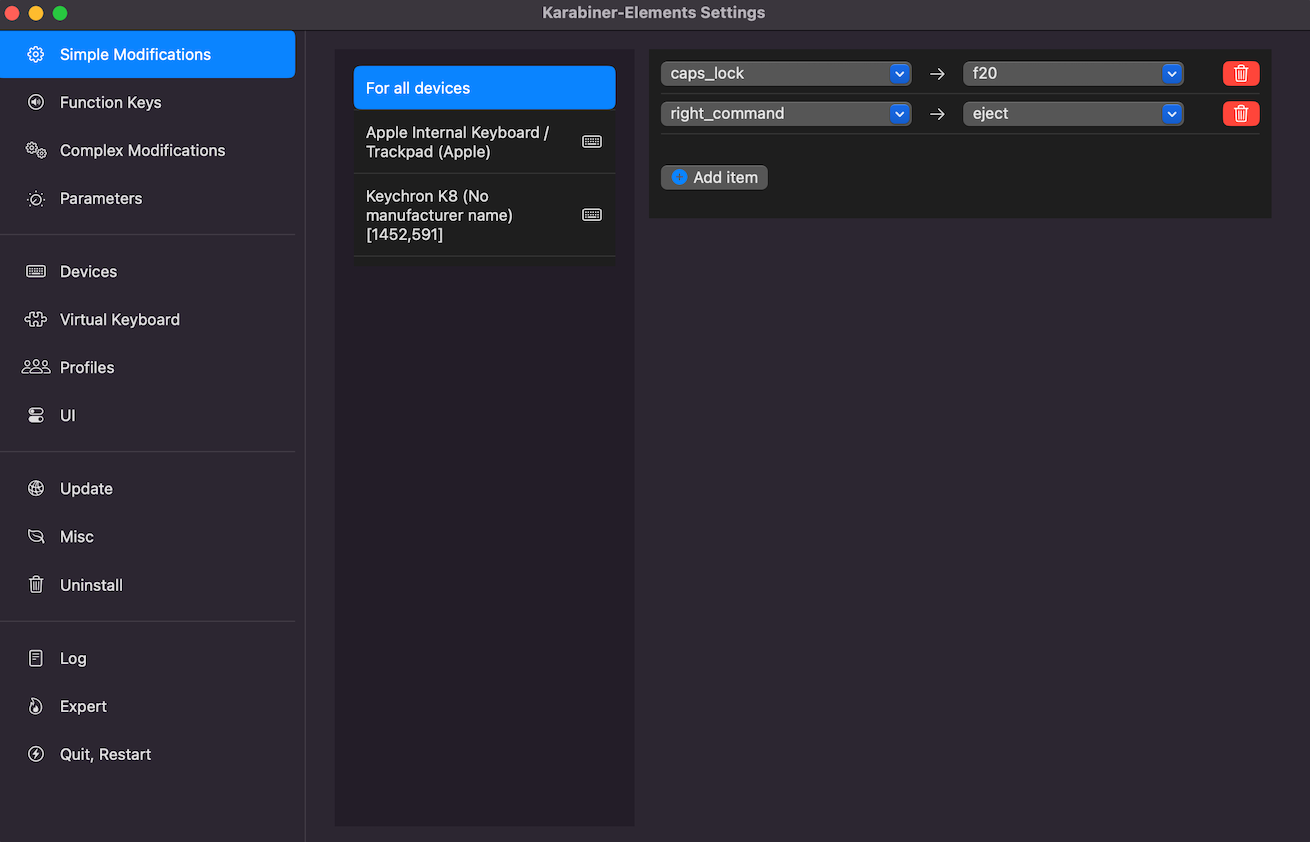
Open iTerm2
Setting->Keys, in theKey Bindingstab, add a mapping fromHex Code 0x10toSend Hex Codes: 0x02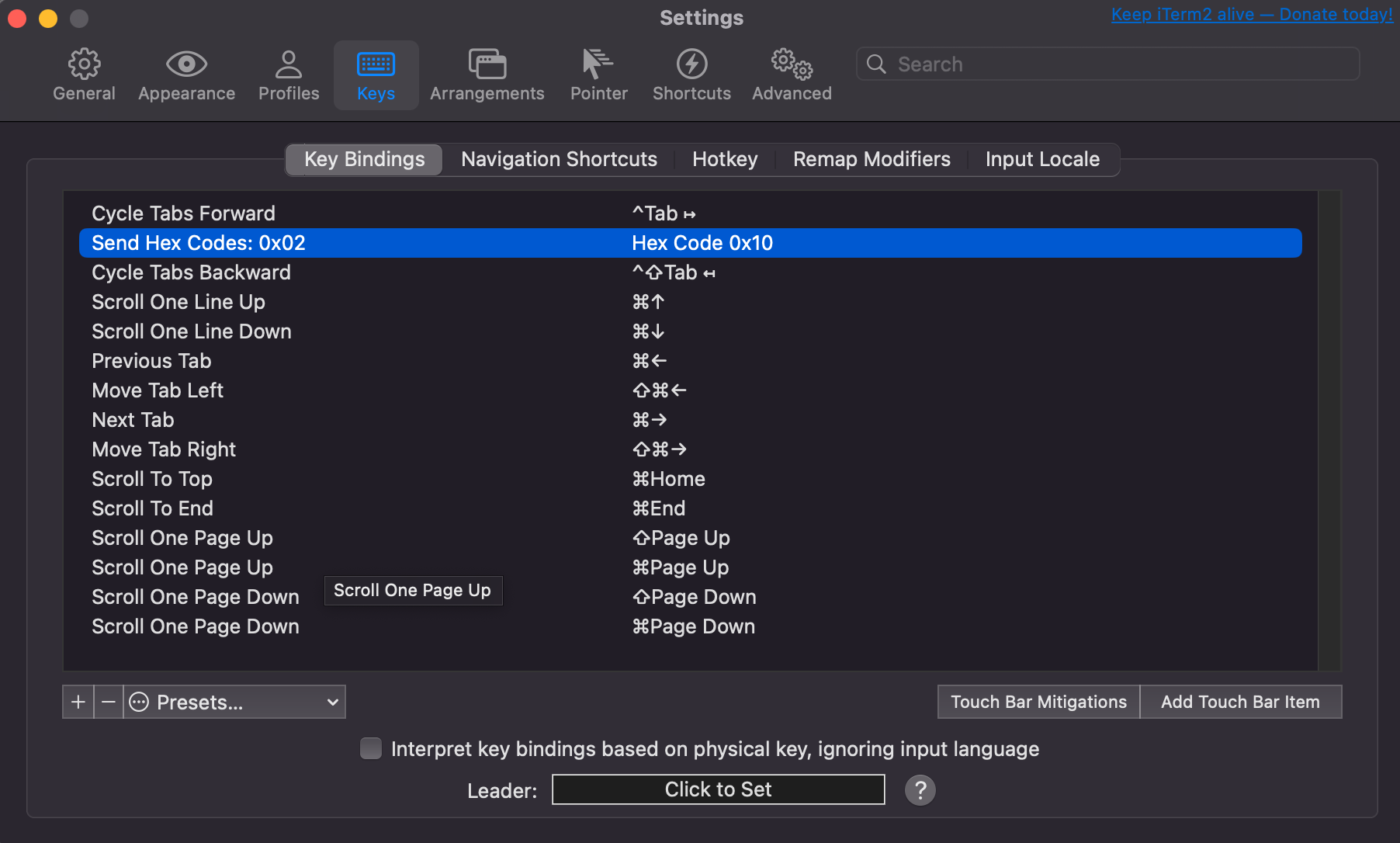
Vim
Install runtime path manager Pathogen
Install vim-sensible
Install vim-colors-solarized
Install vim-go
Update
.vimrc
execute pathogen#infect()

" last position
if has("autocmd")
    au BufReadPost * if line("'\"") > 0 && line("'\"") <= line("$") | exe "normal! g`\"" | endif
endif

set re=0
" solarized color
syntax enable
set background=dark
let g:solarized_termcolors=256
colorscheme solarized

autocmd BufWritePre *.* :%s/\s\+$//e

"python
"let g:python3_host_prog="/usr/local/bin/python3"
"let g:autoformat_verbosemode=1
"au BufWrite *.py :Autoformat

"golang
autocmd FileType go noremap tl :GoDef<CR>
autocmd FileType go noremap th <C-o>
autocmd FileType go noremap tk :GoDoc<CR>
autocmd FileType go noremap <leader>b :GoBuild<CR>
autocmd FileType go noremap <leader>r :GoRun<CR>
autocmd FileType go noremap <C-k><C-k> <C-x><C-p>

let g:go_gopls_enabled = 1
let g:go_gopls_options = ['-remote=auto']
let g:go_def_mode='gopls'
let g:go_info_mode='gopls'
let g:go_referrers_mode = 'gopls'
"let g:go_def_mode='guru'
"let g:go_gocode_propose_source=0
let g:go_code_completion_enabled = 1

let g:go_metalinter_enabled = []

"let g:go_metalinter_command = 'golangci-lint'
"let g:go_metalinter_command = 'golint'
let g:go_metalinter_autosave = 1
"let g:go_metalinter_autosave_enabled = ['vet','revive','errcheck','staticcheck','unused','varcheck']
let g:go_metalinter_autosave_enabled = []
let g:go_rename_command = 'gopls'

filetype plugin indent on
set hlsearch
set nu
set cursorline
set paste
" show existing tab with 4 spaces width
set tabstop=4
" " when indenting with '>', use 4 spaces width
set shiftwidth=4
" " On pressing tab, insert 4 spaces
set expandtab

set viminfo='20,<1000
Fix Slow VIM Auto-Save
This is most likely caused by malfunctioning gopls server.
Try delete gopls index and restart its server:
rm -rf ~/Library/Caches/gopls/*
killall gopls
Opening a new .go file should start gopls server automatically.
.ssh
It is ok to copy over .ssh folders with existing private and public keys
Fix for Golang Build Freeze on Small EC2 Host
when your RAM fills up (e.g., during go build), the kernel pages out less-used memory to this file on disk instead of freezing or killing processes. It’s slower than RAM but prevents the machine from locking up.
# 1. Create a 4GB file filled with zeros — this becomes the swap space
sudo fallocate -l 4G /swapfile

# 2. Restrict permissions — only root should read/write swap (security)
sudo chmod 600 /swapfile

# 3. Format the file as swap space (writes a swap header)
sudo mkswap /swapfile

# 4. Activate it immediately — kernel starts using it as overflow memory
sudo swapon /swapfile

# 5. Make it persist across reboots by adding to filesystem table
echo '/swapfile none swap sw 0 0' | sudo tee -a /etc/fstab